

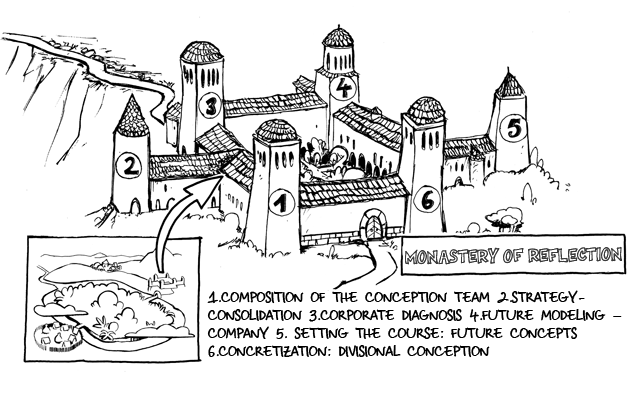






Future divisional heads develop concepts outlining the future and consolidate these with their own internal teams. Following this, the divisional heads and the conceptual team work together to create cohesive alignment of divisional concepts.
Each concept should show how a division will contribute strategically, how it is to be organised and how it plans to achieve this. When this has been clearly demonstrated, the divisional concepts are fully mature.
The strategy you have developed will be honed down to important cornerstones and its core message (the distilled strategy). The purpose of this is to find those elements that will gradually become part of the fibre of your organisation.
It is a matter of turning an abstract strategy into something that all members of your company can relate to in terms of their day-to-day business, so that everyone is heading in the same direction. This provides the foundation for the rest of the process.
Establishing a diagnosis involves identifying important causes and levers, as well as inter-connections that impact on the strategy concept and execution.
To do this, the conceptual team will specifically ask all employees for their evaluation of the company. This ensures that differing opinions outside of the official structures are taken into account to reflect the company's current status quo, its unwritten rules and interconnectivity.
The conceptual team thinks through and plans each relevant business unit or division to decide on a "centralised", uniform format of results. The level of detail depends on the strategy, the current situation and each executive's (i.e. future divisional head) field of expertise.
Parameters should be set that demonstrate how each division will meet the strategic demands without compromising day-to-day operative demands.
Four to eight models are developed to form the core of the strategy concept. These models represent a coherent and compact picture of how the company should function in the future (the business concept). This includes several indispensable elements: a business model, added-value levels, organisational model, management and leadership models. Depending on your strategy you may also need other models e.g. a sourcing model. It is important to keep the models as streamlined as possible. This is done by continually revising the reasons for having these models.
Who has the necessary operative know-how to break down the existing framework, to leave it behind strategically and to rebuild a new framework?
The conceptual team needs people who are able to imagine how everything will work and be interlinked when a new strategy is in place. They need the courage to examine old structures critically and to believe in change. This includes first starting with themselves when it comes to change.

Richard Lutz
“When it comes to execution weaknesses, Matthias Kolbusa identifies the core issues. His ‘prescriptions’ may be challenging at times, but they are always effective.”
Prof. Dr. Carsten Intra
“The ProgressMaker approach consistently steers the entire team toward a stronger focus on results and progress.”
Dr. Volker Hentschel
“Good strategies are one thing; consistent implementation management another. Anyone who wants to achieve excellence in both and drive topics forward even faster will find a valuable partner in Matthias Kolbusa.”

Dr. Carsten Sührig
“Kolbusa has the methodological skills and empathy to create an atmosphere that pragmatically but stringently helps teams set their own goals and consistently implement them.”
Michael Kundel
“Kolbusa brings extreme clarity and structure to challenging projects and has a talent for combining them with a momentum that is characterized by the highly productive cooperation of all the participants.”

Dr. Leonhard Birnbaum
“Time and again Matthias Kolbusa manages to put complex management issues in a nutshell.”
Prof. Dr. Burkhard Schwenker
“Real success lies beyond the mainstream. Matthias Kolbusa shows how to find it.”
Heike Niehues
“Kolbusa brings an incredible clarity through his direct, challenging and sometimes relentless, but always positive and motivating view, which leads to great bursts of energy and inspiration in management teams. Super and very helpful, especially for time-critical, uncomfortable or even complex topics.”
Carsten Evers
“I don’t know what is most important when working with Kolbusa – his methodological competence, his tenacity in continuously insisting that you maintain a focus on the joint goal, or his ability to win over all the different players and keep everything down to earth.”
Dr. Jörg Ritter
“It is amazing how Mr. Kolbusa makes complexities manageable and discussable. This is the way to generate true management commitment.”
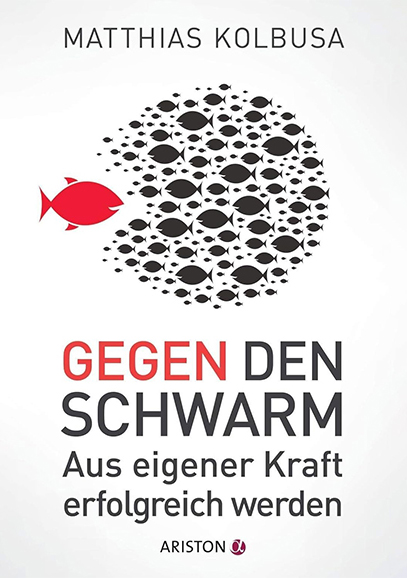
Against the swarm
How to be successful by virtue of our own strength